Back to News
September 22, 2026
At a Ras Al Khaimah school library, Code Orbit teaches its youngest students yet how to think like researchers
By Code Orbit
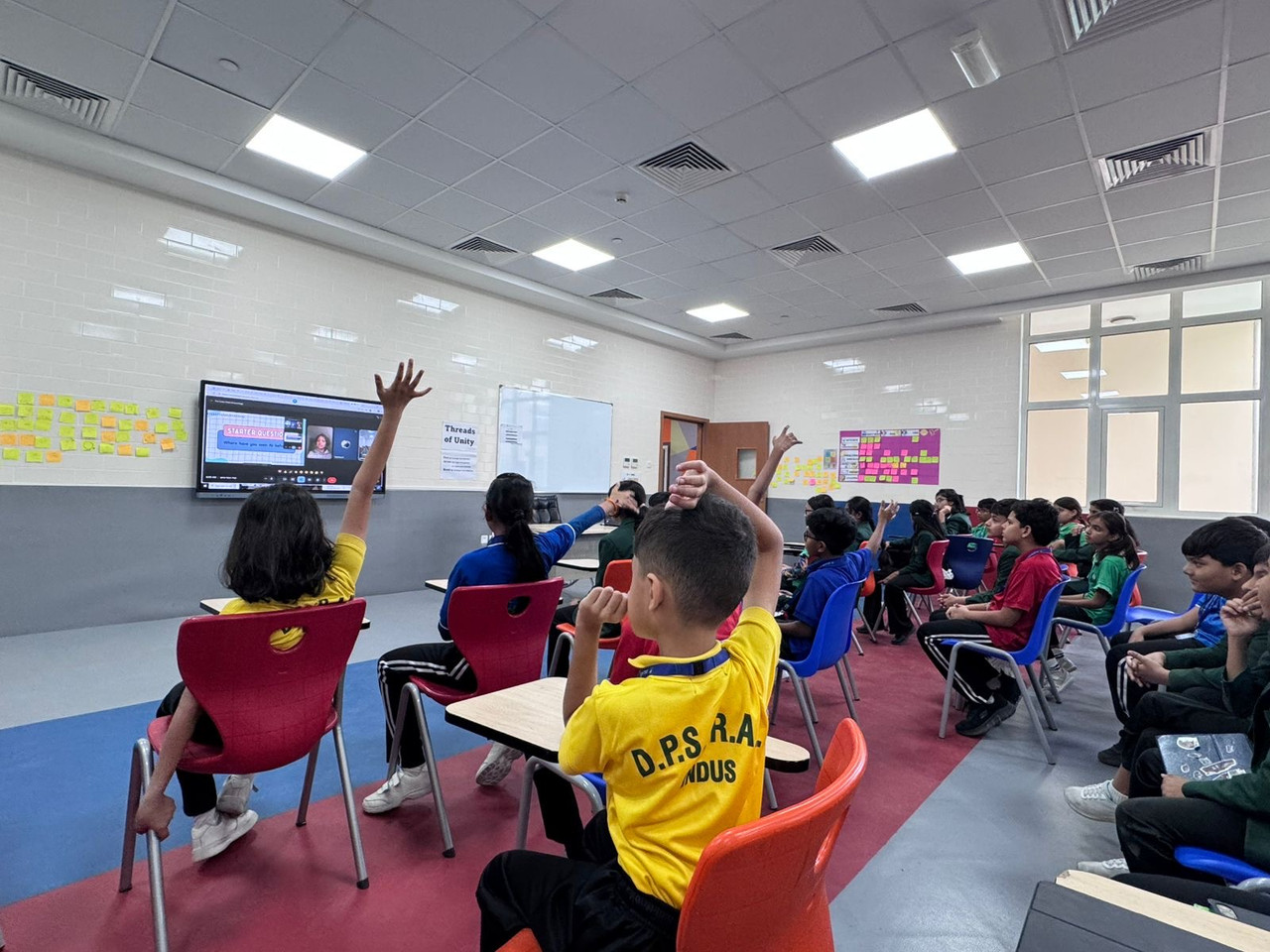
The classroom at Delhi Private School in Ras Al Khaimah was rearranged for the occasion: chairs pulled into a loose circle, a projector screen connecting mentors from different time zones, and a room full of elementary school students about to encounter a question they were rarely asked in school—not “what did you learn?” but “how do you decide what is worth learning about?”
For Code Orbit mentor Afia Khanam, the answer begins with curiosity.
The September 22, 2026 session marked Code Orbit’s first workshop in the UAE and its youngest audience to date. Instead of beginning with a coding tutorial or a conventional lesson, Khanam and the mentors introduced students to a habit that can precede both: learning how to turn curiosity into a question worth investigating.
“Most students meet ‘research’ for the first time as a homework assignment, with the topic already chosen for them,” Khanam said. “We wanted to hand that decision back to them, early, before it starts to feel like a chore.”
The 90-minute session began with a short physical warm-up before moving into discussion and activities. The goal was deliberate: make research feel less like another classroom assignment and more like something students could actively explore.
The central activity introduced six questions—what, why, how, where, who, and when—as a simple framework for examining an idea. Students then applied the questions to situations drawn from their own lives: a disagreement on the playground, a chore they did not understand, or a game they wished worked differently.
The exercise shifted the focus from finding the “right” answer to asking better questions. Students had to consider not only what interested them, but why it mattered, who was affected, what they would need to know, and where they might begin looking for answers.
That approach reflects a broader philosophy behind Khanam’s work with Code Orbit: technology education should not stop at tutorials. Students should have opportunities to build, investigate, test ideas, and solve problems with guidance from people who can help them take the next step.
The Ras Al Khaimah workshop grew from the same model Code Orbit has used since beginning as a small library program in 2024. The organization has since conducted more than 50 workshops and 20 AI awareness sessions, connecting students with mentors for project-based learning in areas ranging from introductory programming to data analysis and research.
For Khanam, bringing that model to a younger audience was not simply about teaching research earlier. It was about changing how students see themselves—as people capable of identifying questions rather than waiting for someone else to provide them.
The session also relied on close collaboration with Delhi Private School Ras Al Khaimah. Teacher and coordinator Ms. Maimoona Khan worked alongside the mentors throughout the workshop, helping the activities move smoothly and keeping students engaged.
The organizers are now discussing a second session at DPS later this term. Rather than stopping at the six-question framework, students would choose topics of their own and begin taking them through the early stages of actual research.
For a group of elementary school students, the workshop began with a simple question.
For Code Orbit, it was an extension of a larger idea: meaningful technology education begins before students know exactly what they want to build. Sometimes, it begins when they learn to ask what is worth investigating.
Code Orbit is a student-led nonprofit providing free coding, AI, and STEM education to learners worldwide.
For Code Orbit mentor Afia Khanam, the answer begins with curiosity.
The September 22, 2026 session marked Code Orbit’s first workshop in the UAE and its youngest audience to date. Instead of beginning with a coding tutorial or a conventional lesson, Khanam and the mentors introduced students to a habit that can precede both: learning how to turn curiosity into a question worth investigating.
“Most students meet ‘research’ for the first time as a homework assignment, with the topic already chosen for them,” Khanam said. “We wanted to hand that decision back to them, early, before it starts to feel like a chore.”
The 90-minute session began with a short physical warm-up before moving into discussion and activities. The goal was deliberate: make research feel less like another classroom assignment and more like something students could actively explore.
The central activity introduced six questions—what, why, how, where, who, and when—as a simple framework for examining an idea. Students then applied the questions to situations drawn from their own lives: a disagreement on the playground, a chore they did not understand, or a game they wished worked differently.
The exercise shifted the focus from finding the “right” answer to asking better questions. Students had to consider not only what interested them, but why it mattered, who was affected, what they would need to know, and where they might begin looking for answers.
That approach reflects a broader philosophy behind Khanam’s work with Code Orbit: technology education should not stop at tutorials. Students should have opportunities to build, investigate, test ideas, and solve problems with guidance from people who can help them take the next step.
The Ras Al Khaimah workshop grew from the same model Code Orbit has used since beginning as a small library program in 2024. The organization has since conducted more than 50 workshops and 20 AI awareness sessions, connecting students with mentors for project-based learning in areas ranging from introductory programming to data analysis and research.
For Khanam, bringing that model to a younger audience was not simply about teaching research earlier. It was about changing how students see themselves—as people capable of identifying questions rather than waiting for someone else to provide them.
The session also relied on close collaboration with Delhi Private School Ras Al Khaimah. Teacher and coordinator Ms. Maimoona Khan worked alongside the mentors throughout the workshop, helping the activities move smoothly and keeping students engaged.
The organizers are now discussing a second session at DPS later this term. Rather than stopping at the six-question framework, students would choose topics of their own and begin taking them through the early stages of actual research.
For a group of elementary school students, the workshop began with a simple question.
For Code Orbit, it was an extension of a larger idea: meaningful technology education begins before students know exactly what they want to build. Sometimes, it begins when they learn to ask what is worth investigating.
Code Orbit is a student-led nonprofit providing free coding, AI, and STEM education to learners worldwide.